THE DOJ SCAM EXPOSED, FINALLY!

 On May 21, 2025, the Department of Justice announced that they had closed their investigation into the Phoenix Police Department and “retracted” the findings.
I’m not sure what that means because the findings report is still available and can be reviewed and referenced by anyone who wants to continue perpetuating the lie that it painted about our department.
Don’t get me wrong. I am thankful that the investigation is closed for now. However, without legislative intervention, there is a substantial risk that the investigation will be revived if or when the political winds shift and we have a different White House resident.
Dr. Travis Yates and Dr. JC Chaix conducted a thorough review of the findings report released by the DOJ. They were able to make a side-by-side comparison of that information with the public-facing website that the city created to provide all of the factual information to the community. What they found after several months of investigation is nothing short of criminal. Here is a LINK to the full report.
Here is a list of their key findings:
-
- Nearly 97% of the incident descriptions in the US Department of Justice (DOJ) report are factually and/or contextually inaccurate.
- Of the 132 incident descriptions in the DOJ report, 116 were found to be factually inaccurate, 12 could not be determined, and only 4 were factually and/or contextually accurate.
- The DOJ report lacks a clear definition and delimitation of a “pattern” or “practice” of unconstitutional policing and lacks valid qualitative or quantitative means of assessment.
- In more than a few cases, the incident descriptions evidenced a peculiar, prescriptive insistence based on advocacy rather than case law.
- The DOJ descriptions evidence misinterpretations of case law, constitutional law, public safety best practices, and proven law enforcement policies, training, and tactics, and demonstrate hindsight bias far beyond the scope of extant case law.
- In some cases, the descriptions in the DOJ report were tied to remedies that lack clear delimitations, making the satisfaction of a consent decree immeasurable, unattainable, and ultimately discretionary according to (unclear and undefined) DOJ metrics and benchmarks (presuming that the DOJ will define such necessary metrics and benchmarks).
- Consent decrees, by their nature, are punitive and responsive—and lack demonstrative evidence of their effectiveness despite decades of enactment in multiple cities—and the DOJ report specified no metrics or benchmarks for accurate monitoring and assessment of DOJ-prescribed consent decree mandates.
Consider what would happen to a police officer if it was determined that 97% of their police reports were determined to be factually or contextually inaccurate. I would expect that police officers would find themselves no longer employed, their certifications in jeopardy, and potentially prosecuted—and rightfully so.
So, what happens to the DOJ attorneys and researchers who misrepresented incidents and lied about information in an apparent attempt to influence, intimidate, and strongarm our city council into signing an “agreement in principle” that would require them to negotiate a consent decree that would have cost our community upwards of $10 million a year? I will give you the answer, NOT A THING. The findings report intentionally omits the names of actual authors to avoid liability. For former Assistant Attorney General Kristin Clark to have disseminated a report like this and represented it as factual should, at the very least, cost her her BAR license. Anyone involved in this farce should be held to account for their involvement.
Moving forward, we are working on a plan to prevent the Department of Justice from ever intervening and attempting to force a community to subject its police department to federal oversight by individuals who have never been police officers and have no interest in public safety.
The current Assistant Attorney General, Harmeet Dhillon, who oversees the Civil Rights Division, has been highly critical of consent decrees, federal judges, and the for-profit monitors chosen to manage the decrees. I only hope that her criticism leads to action to prevent this fraud from being perpetrated on a community again.
Moving forward, PLEA is committed to brokering a change to the system so that it will take more than a swipe of the Executive Order pen to undue.
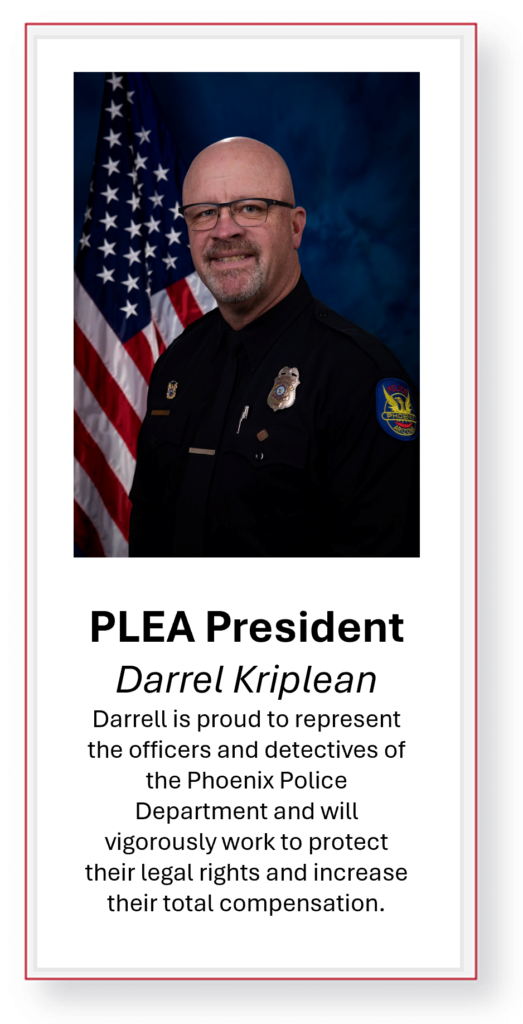
If you have any questions or comments, I can be reached at the PLEA office or by email at dkriplean@azplea.com.